|
|
Other
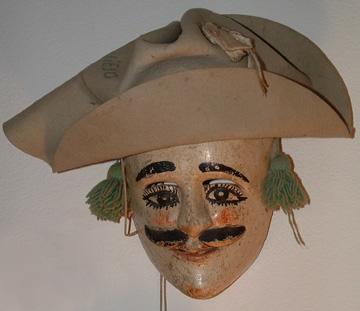
"My Dead Uncle" Masks In 1988, a close Mexican friend and I were touring local villages near his home town of Huejucar, Jalisco, searching for masks. The region has a rich tradition of dances, the most popular being the dances of the Pastorelas and the Morenos. A local merchant of a "Ranchito" (as my friend referred to the small villages near Huejucar) told us of a family that might have an old mask. We knocked at the door of a dirt floored house - the young girl of about 14 told us her mother wasn't home but she eagerly agreed to show us the mask anyway. She pulled it from a chest and unwrapped it - a simple but charming jester from the Dance of the Morenos. It was well worn with a nice patina and a wool felt hat inscribed with the touching words, "mira mi viejo" (click here.) It had belonged to her uncle and she didn't think her mother wanted to sell it, but she advised us to return the following day to speak with her mother. Ever perceptive, my friend took it on his own to leave the girl with a nice propina, or tip, to express our hopeful appreciation. The following day when we spoke with her mother about buying the mask, she turned to her daughter in ambivalence and asked her opinion of the sale. It was clear she did not really want to sell her brother's mask, but the young girl, not having divulged the propina she had received from us, gave her mom a gentle nudge on our behalf, thus helping to close the deal. Whether one finds this tale to be humorous or immoral, it illustrates accurately the sometimes disturbing resourcefulness and tenacity which can be found in collectors of masks - or collectors of anything for that matter. A decent collection is not amassed by leaving good material behind after spending one's time and money trying to find it. As any collector knows in his heart, the end usually justifies the means; and the bottom line is that one must get the piece or later suffer painful regrets (click here). Another item for the introspective collector of ethnic art to contemplate is that these old pieces, fragile with age and left in their native environs, will eventually be broken, damaged, lost, or infested by insects (click here) unless they find their way into the protective hands of private collectors and museums. Following this thought, one might deduce that the collector thus need not fret over the precise circumstances of an acquisition. Clearly, some readers may differ philosophically on this view - and if you take exception either way, please rest assured that your sovereign right to your own opinion is respected at this website.
|